
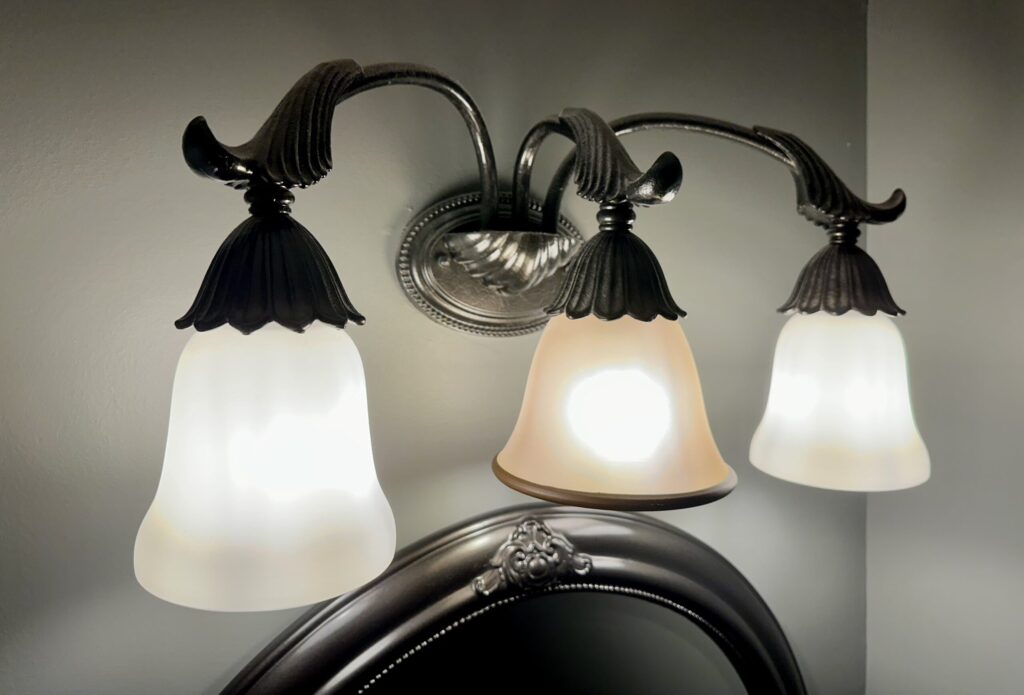
Two cans of spray paint. Three $2 glass covers. Twenty-six dollars, all in.
That’s what it took to get rid of the gold in our half bathroom, the small one right inside the front door. My wife gasped when she first walked into it on the house tour, and not in a good way. Textured gold walls, an ornate gold mirror frame and a matching gold light fixture, all packed into a tiny room. It felt like stepping into a different decade.
The short version: I spray painted the mirror frame and the light fixture with Rust-Oleum Metallic Dark Bronze, three coats each. More than three years later there’s no chipping and no obvious wear, and unless you look closely, it reads like a brand-new matching set.
Why we painted instead of replacing
We were already stretching the budget with the move, and new fixtures would have run $150 to $300. We spent weeks looking anyway. Everything we liked was expensive, and everything affordable looked cheap. When we caught ourselves considering a $200 light fixture for a half bathroom, we stopped.
The thing is, we liked the shape of what we had. Just not the color. And since we didn’t like the gold anyway, there was nothing to lose. If the paint failed, I could replace the mirror with a $25 one from Amazon. It’s the same math that later had us refinishing our tub with a Rustoleum kit instead of replacing it, and painting the stained baseboards instead of ripping them out.
What I bought: two cans of Rust-Oleum Metallic Dark Bronze at $10 each, and three new glass light covers at $2 each. I already had painter’s tape, cardboard and a utility knife.
The mirror: taping was the fun part
The mirror came off the wall with one screw. I set it on a cardboard box in the garage with the door open for ventilation.
Instead of covering the glass with paper, I ran painter’s tape across the entire mirror face in parallel strips. I’ll admit I enjoyed this more than I should have. Then I trimmed the tape with a utility knife right where the mirror meets the frame, angling the blade slightly under the frame edge so the paint would cover the frame all the way to the glass without touching it. That part took patience.
My first coat was pretty terrible
I started with the can about 4 to 5 inches from the frame. That left little dark splotches and puddles of thick paint. The raised pattern on the frame made it worse, because spraying from one direction missed the grooves completely. I finished that first coat thinking I’d ruined it.
Then it dried, and most of the puddles smoothed themselves out.
Backing off to 8 to 10 inches gave me even coverage without drips. Check the instructions on your can, because the right distance varies. For the textured parts, I had to come at the frame from several angles and use a circular motion to get paint into the recesses.
The light fixture went faster
By the time I got to the light fixture, I knew what I was doing. I shut off the power at the breaker, took the fixture off the wall, and only had to tape the three socket openings.
Smooth, steady passes kept it from streaking. Circular motion covered the textured parts. Keeping the same distance the whole way gave me a uniform finish, and waiting between coats kept me from rushing into mistakes.
It took three coats on both pieces to completely cover the gold. If I’d known what I was doing from the start, I probably could have done it in two. Total hands-on time was about an hour and a half.
What went wrong
The cardboard box I used under the mirror was too small. There’s now a black patch of spray paint on the garage floor that isn’t going anywhere. Go bigger on protection than you think you need.
I also didn’t press the tape edges down firmly enough in a couple of spots, so a little paint leaked onto the edge of the mirror. Up close, you can still find two tiny gold spots where the tape didn’t seal, a couple of darker spots from my early technique, and some slight texture differences where I over-sprayed. You have to be looking for them.
How it’s held up
More than three years later, there’s no chipping and no obvious wear on either the mirror frame or the light fixture. The only casualty was a glass cover I broke changing a bulb, which had nothing to do with the paint.
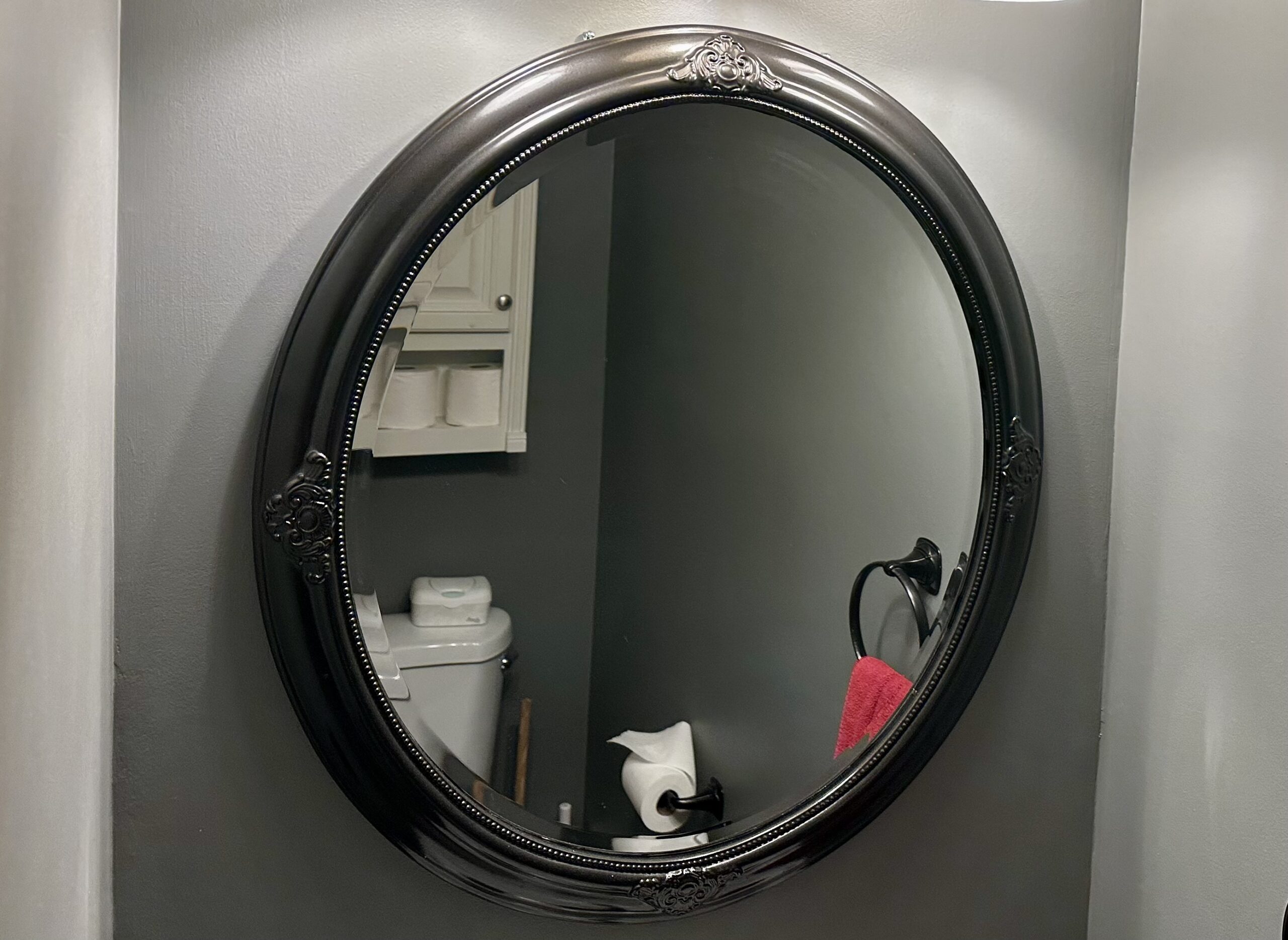
What I’d do differently: cover the mirror glass with paper and tape instead of taping the whole face, which would have been faster. Buy a trigger attachment for the spray can, because my finger cramped. Use a bigger drop cloth. And practice on a piece of cardboard first to get the distance and motion right before touching the real thing.
It gave me enough confidence that I’ve since spray painted our fire pit several times with grill paint, plus our gas line.
It works best on fixtures you already don’t like, with solid parts that don’t move or get handled much, like mirror frames, light fixtures and hardware. I’d skip it for anything that gets touched constantly or has water running over it, for fixtures that are damaged or poorly made, and for anything you actually love the way it is.
Products used: Rust-Oleum Metallic Dark Bronze spray paint (two cans), replacement glass light covers, painter’s tape, cardboard, utility knife.
Common Questions
Eight to ten inches gives even coverage without drips. Closer than that — four to five inches — creates thick splotchy patches. Most distance mistakes smooth out as the paint dries, so don’t panic if the first coat looks rough. Read the instructions on your specific paint — the recommended distance varies by brand.
Three coats fully covered the original gold finish on both the mirror frame and the light fixture. The first coat shows the coverage gaps, the second improves things, and the third gives a consistent finish. If you’re experienced with spray paint, you might get there in two coats — but plan for three.
Three-plus years with no chipping or obvious wear on the mirror frame and light fixture body. Static surfaces in bathrooms hold up well. Moving parts, anything with direct water contact, or high-friction surfaces are poor candidates — the finish won’t last there. Humidity matters less than direct contact and wear.
Best candidates are solid non-moving surfaces: mirror frames, light fixture bodies, cabinet hardware. Skip faucets, handles, or anything that gets touched regularly or has water running over it — the finish won’t hold up under that kind of wear. If you’re unsure, start with something you already plan to replace; that way a failed experiment costs only the paint.