
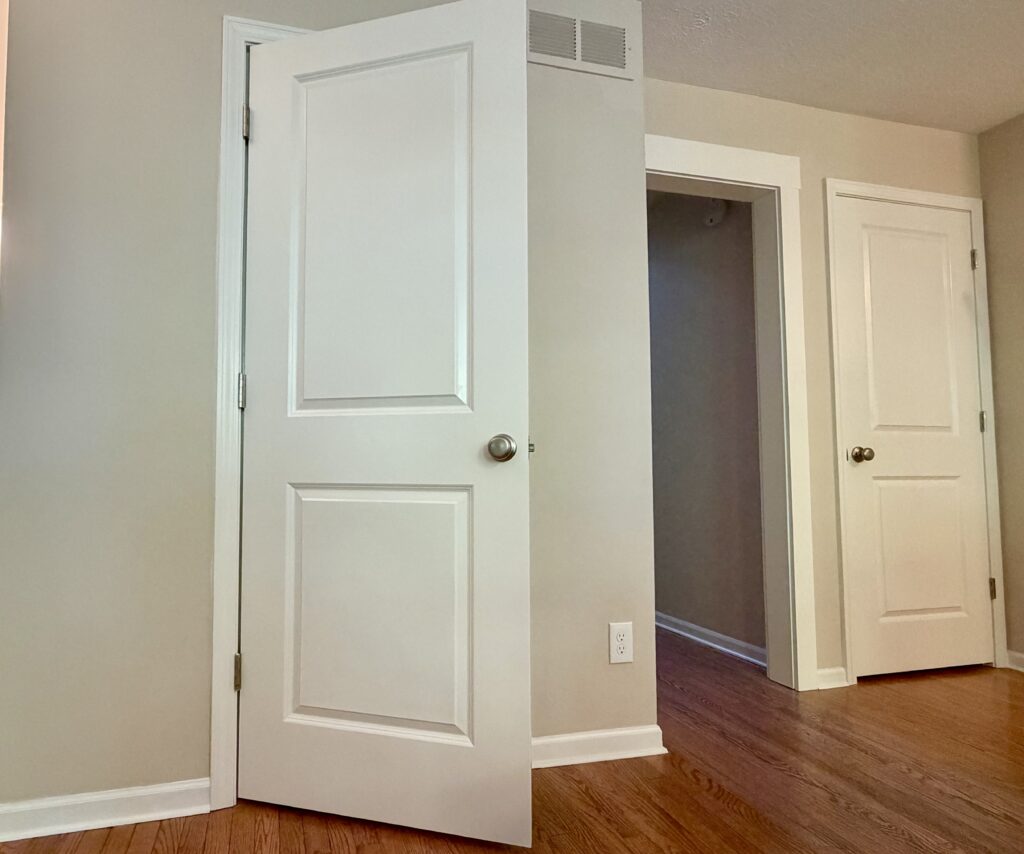
Five years ago, stuck at home during the pandemic, I pulled out the first of 14 interior doors in our 1980s house. Last month, I finally finished the last one.
Fourteen doors. Sixty months. More trips to the hardware store than I care to count. And a hamstring that still remembers the early days before I found a better way to work solo.
If I started over, I’d do three things from the first door: buy the inflatable lifting bag, shim the hinge side before the door comes in, and test the latch before the last nails go in. The rest of what I learned is below.
The doors were one piece of a bigger job: getting rid of the orange 1980s oak everywhere, including the baseboards and the stair spindles.
Start with prehung. Don’t second-guess this.
Every door I replaced was prehung — meaning the door comes already mounted in its frame, hinges and all. You’re not transferring hinge locations, cutting mortises or hoping your measurements match an existing frame.
For an older house like mine, where almost nothing is perfectly square, prehung was the right call. Our frames were dinged, dented and orange-stained from the previous owners. I wanted a fresh start, not to work around what was already there. Prehung gave me that.
If your frame is in good shape and you’re comfortable with more precise work, a slab door (just the door panel, no frame) is cheaper. But for a first-timer replacing multiple doors, prehung removes a lot of variables.
Every door is its own problem
Of the 14 doors I replaced, no two were exactly the same situation.
Some were hinged close to a corner, leaving almost no room to swing a hammer. One was at the top of a staircase, which added a layer of caution I hadn’t planned for. Two doors were barely a couple of feet apart, creating clearance problems when both were open. And the flooring varied throughout the house — thick carpet in the bedrooms, vinyl in the bathrooms, transition strips at some doorways — which meant the gap at the bottom of each door had to be figured out individually.
This is worth knowing going in: the guides that make door replacement look simple are usually showing you one door, in a room with normal clearances, on a level floor. Real houses aren’t always like that. Budget extra time for the doors that aren’t straightforward.
If several doors in the same part of the house start sticking, that’s worth looking into before you start replacing — it can be one of the earlier signs of foundation movement, though usually it’s just seasonal wood movement or humidity.
The left-hand, right-hand thing will break your brain. Here’s how to solve it.
I bought the wrong door on my first attempt. Not the wrong size — the wrong hand.
If you’ve ever tried to figure out whether you need a left-handed or right-handed door, you know how fast the explanations on the box or the hardware store website stop making sense. I finally found one explainer that actually worked: stand with your back against the hinge side of the door frame. Whichever side the doorknob is on when the door opens is the hand you need.
That’s it. That one test would have saved me a wrong door.
The silver lining: the wrong-handed door I bought for one room worked perfectly in another room I was planning to do later anyway. A small win.
Stop watching so many videos before you start
There is no single right way to hang an interior door. Some guides say shim the hinge side before you bring the door in. Some say place the door first and shim to the jamb. Some swear by laser levels. Some use plumb bobs. Some use wood screws throughout. Some use nail guns throughout. Some use a combination.
I made the mistake of trying to incorporate all of it at once. On my first few doors, I had a plumb bob, a laser level, a regular level, a square and a stack of shims going simultaneously. They often gave me slightly different readings, and I spent more time second-guessing my measurements than actually installing doors.
What I eventually settled on: a 6-foot level, a square, a nail gun for the latch side and three wood screws through the hinge side. That’s it. Pick a method that makes sense to you and stick with it long enough to get good at it.
Get the inflatable bag. Seriously.
This was the single biggest game-changer of the entire project.
Working alone, I was contorting myself trying to hold the door in place, keep the jamb off the floor, drive a screw, check for level and not drop anything — all at the same time. It was slow, awkward and occasionally dangerous near the top of stairs.
Then I watched a video where someone used a small inflatable bag — the kind you squeeze air into by hand — wedged under the door to hold it exactly where they needed it while they worked. Available at any hardware store, under $20. They come in a pack with different sizes and widths. I had never heard of it before and it saved me hours.
If you’re doing this solo, get this tool.
Shim the hinge side before the door comes in
Once I started doing this, everything got easier.
Before bringing a new door into the room, I’d shim the hinge side of the rough opening — using the old door’s position along the floor and baseboards as my reference point. By the time the new door came in, I wasn’t trying to simultaneously hold a heavy solid-core door and adjust shims along the frame. The frame was already set. I just lifted the door into place and screwed it in.
Solid-core doors are heavier than they look. Anything that reduces the amount of time you’re wrestling with one is worth doing.
Test the latch before you finish. Every time.
I learned this one the hard way, twice.
A door can look perfectly level on both sides and across the top, but if the latch hole isn’t lined up precisely with the strike plate, the door won’t close right. And once you’ve nailed off the latch side and called it done, fixing that misalignment is a lot more work than the 10 seconds it would have taken to test it first.
Before I drive the final nails on the latch side, I now close the door and test the latch. It sounds obvious. I still have to remind myself to do it.
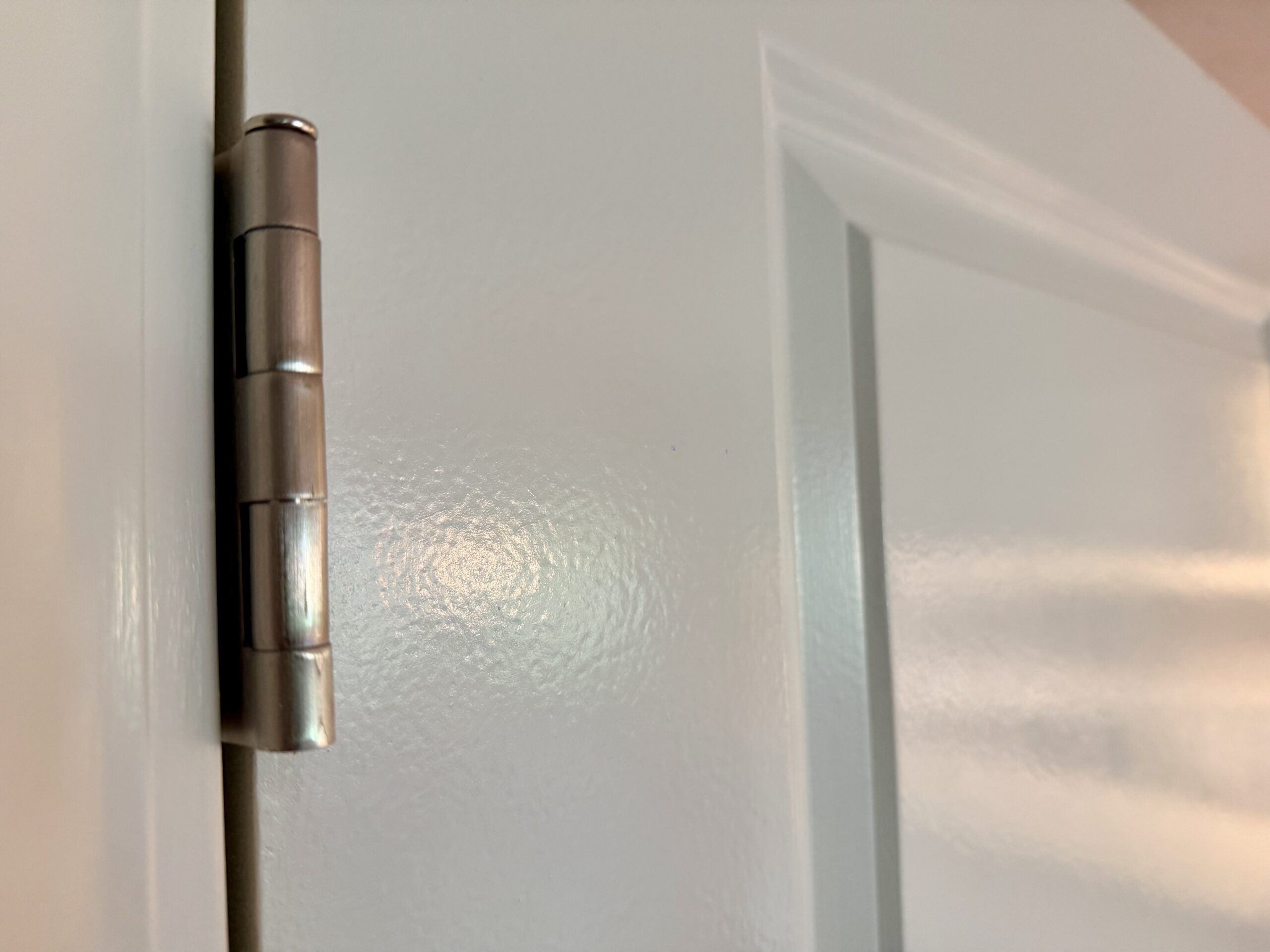
Don’t use caulk on nail holes
Early on, I used paintable caulk to fill nail holes and the small gaps where the jamb meets the wall. It looked fine for a couple of hours. Then it shrank, cracked and looked worse than the holes.
Switch to spackle or wood filler. It takes a coat of paint better, doesn’t shrink and won’t crack along the edges. Small thing, noticeable difference.
The small doors are harder to find than you think
The 30-inch doors — bedrooms, bathrooms — were easy. Every big box store carries them.
The 18-inch closet doors were a different story. I ended up at a specialty lumber store to find the right size, and even then the hinges and door jamb edges didn’t always match the other doors from the same manufacturer and style. Budget extra time for sourcing if you’re replacing closet or small utility doors.
One more thing on sourcing: not every hardware store is interested in helping a first-timer figure out where to start. I walked out of one large lumber company after it became clear no one was going to help me. Fortunately there were plenty of other places willing to help — and to take my money. If a store makes you feel like a burden, go somewhere else.
The most important thing I learned
Doors are more forgiving than you think.
I spent the first year aiming for perfect. I’d fuss over a 1/16-inch gap, re-shim something twice and stand there staring at a door for ten minutes wondering if it was right.
What I eventually figured out: trim covers a lot. Doors are going to door, for the most part, as long as they’re reasonably plumb and the latch catches. The early doors I agonized over look fine. The later doors I installed with more confidence and less second-guessing look just as good.
Trust your level, test your latch and keep moving.
Tools used: prehung interior doors, 6-foot level, carpenter’s square, inflatable door lifting bag, nail gun, 3-inch wood screws, spackling, wood filler.
Step by Step
How to install a prehung interior door solo.
- Shim the hinge side before the door comes in
Using the old door’s position as your reference, shim the hinge side of the rough opening before bringing in the new door. This way you’re not trying to hold a heavy solid-core door and adjust shims at the same time.
- Bring the door in and seat it against the shimmed side
Lift the new door into the opening and press the hinge side against the shimmed frame. Use an inflatable door lifting bag wedged under the door to hold it at the right height while you work — it frees both hands for screws and level.
- Check plumb and adjust
Use a 6-foot level on the hinge side and latch side. Adjust shims until the door is plumb on both sides. Check the gap at the top of the door — it should be even across the full width.
- Drive screws through the hinge side, then nail the latch side
Drive 3-inch wood screws through the hinge-side jamb and into the framing. Once the hinge side is secured and plumb, nail the latch side. Leave the final nails on the latch side until after you’ve tested the latch.
- Test the latch before finishing
Close the door and test the latch before driving the final nails on the latch side. If the latch doesn’t catch, adjust before finishing. Once you’ve nailed off the latch side, fixing a misaligned strike plate is significantly more work.
Common Questions
A prehung door comes with the frame, hinges and hardware already assembled — you remove the old door and frame together and install the new unit. A slab door is just the door panel, which requires transferring hinge locations and working with the existing frame. Prehung is better for older houses where frames are often out of square, or for first-timers who want fewer variables to manage.
Stand with your back against the hinge side of the door frame. Whichever side the knob is on when the door swings away from you is the hand you need. Every explanation on the hardware store box manages to make this more confusing than it is — the back-to-hinge-side test works every time.
Get an inflatable lifting bag — the kind you squeeze air into by hand — and wedge it under the door to hold it at exactly the right height while you work. Available at hardware stores for under $20. It frees both hands for driving screws and checking level. The other key move: shim the hinge side of the rough opening before the door comes in, so you’re not trying to hold a heavy door and adjust shims at the same time.
A single door in a straightforward location takes most people two to four hours the first time. Doors near corners, at the top of stairs, or in rooms with unusual clearances take longer. The later doors in a multi-door project go faster once the process becomes familiar — but for your first door, plan for half a day.