
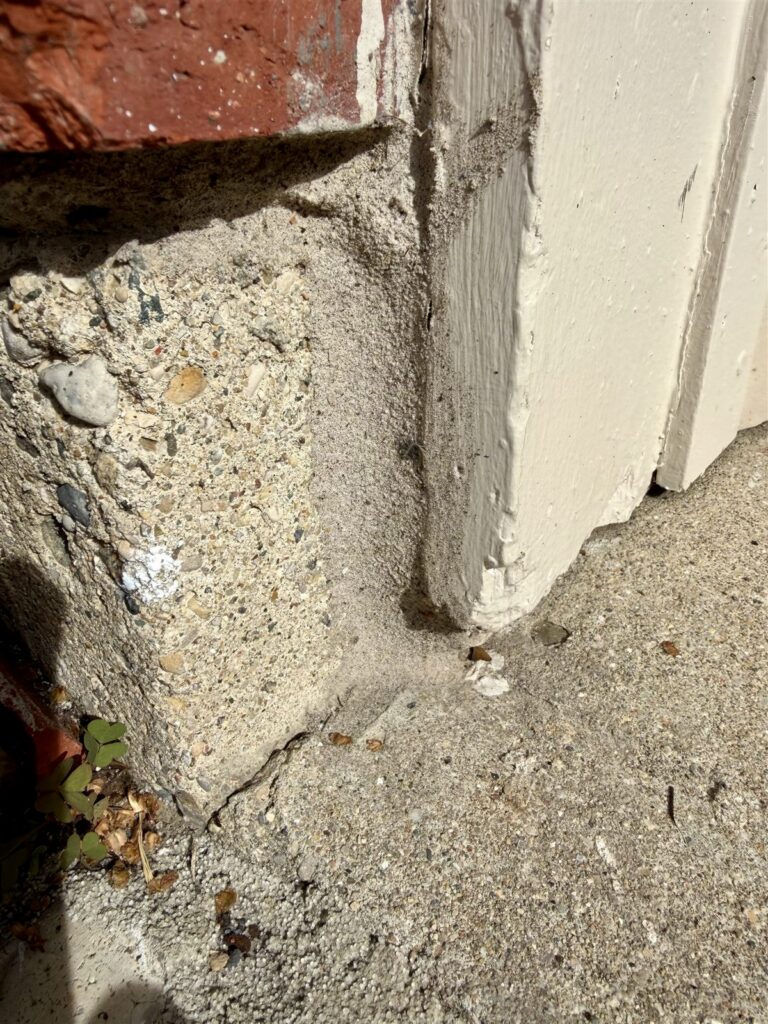
Your house is constantly talking to you through small warning signs like peeling paint, slow drains, and weird noises. Learning to “read” these signals in my first six months saved me thousands in emergency repairs—but only after I made some expensive mistakes first.
Here are 27 warning signs every homeowner should know, organized by how serious they are and what they usually mean.
Structural Warning Signs
These are the ones that matter most. Structural problems are expensive to fix and get worse if ignored.
1. Cracks above windows and doors
Diagonal cracks that radiate from the corners of window and door frames are almost always caused by foundation settlement or movement. A single hairline crack might be cosmetic. Multiple cracks, widening cracks, or cracks accompanied by doors that stick or won’t latch are serious signals. This is one I learned the hard way in my 1950s ranch — ignored it for two years before I understood what it was telling me.
2. Stair-step cracks in brick or block
Cracks that follow the mortar joints in a diagonal stair-step pattern in brick or concrete block indicate differential settlement — one part of the foundation is moving more than another. This is different from a random crack in the brick face, which is usually less serious. Stair-step cracks get professional attention.
3. Horizontal cracks in foundation walls
Horizontal cracks in a poured concrete or block foundation wall indicate lateral pressure from soil — the ground pushing in from outside. This is the most serious type of foundation crack. Vertical cracks in foundations are often from shrinkage and may be fine. Horizontal cracks are not fine.
4. Doors and windows that stick or won’t close
If multiple doors or windows in the same area of the house suddenly start sticking, that’s a signal that the framing is moving. One sticky door in humid weather is normal. Multiple sticky doors, or a door that used to close fine and no longer does, is worth investigating further. If a door is simply worn out, here’s what I learned replacing all 14 of ours.
5. Sloping or bouncy floors
Floors that slope noticeably, flex underfoot, or feel soft in certain spots can indicate foundation issues, failing floor joists, or rot. A slight slope in a very old house might just be age. A new slope, a soft spot that’s getting worse, or a floor that bounces when you walk across it needs investigation.
Water and Moisture Warning Signs
Water is the most destructive force in a house. Most of it announces itself early if you know what to look for.
6. Water stains on ceilings
A brown ring on a ceiling is water that dried there. It might be from a one-time overflow from the bathroom above. It might be an active roof leak. The stain itself doesn’t tell you which — you have to find the source. Don’t paint over it and forget it.
7. Musty smell
A persistent musty smell almost always means moisture somewhere. Active mold, old water damage that never fully dried, or ongoing condensation. Check under sinks, around water heaters, in crawl spaces and basements, and around window frames. The smell is harder to ignore than the stain, which is useful.
8. Peeling paint near windows or on ceilings
Paint doesn’t peel without a reason. Near windows, it usually means water is getting in around the frame. On a ceiling, it often means moisture from above — a bathroom on the floor above, a roof leak, or condensation. Bathroom ceiling paint that peels repeatedly is often a ventilation problem.
9. Soft spots around the toilet base or under sinks
Press the floor around the toilet base with your foot. If it flexes or feels soft, the wax ring has likely been leaking — slowly, invisibly, long enough to rot the subfloor. This is one of the more expensive surprises in a bathroom. Check it early, before a simple ring replacement becomes a subfloor replacement.
10. Efflorescence on basement walls
White, chalky deposits on concrete or masonry basement walls are called efflorescence — mineral salts left behind when water moves through the wall and evaporates. The stain is benign. The water causing it isn’t. It means water is moving through your foundation wall on a regular basis.
11. Slow drains throughout the house
One slow drain is a localized clog. Multiple slow drains, or slow drains in fixtures that aren’t near each other, suggest a problem in the main line. Gurgling sounds from drains when other fixtures are used is another signal. This is worth addressing before a blockage becomes a backup.
12. Water heater corrosion or rust
Rust-colored water from hot taps, visible corrosion on the water heater tank, or rust-stained rings around the base of the unit are signals the tank is failing. Water heaters typically last 8–12 years. Most fail before they’re replaced. A failing tank gives you a warning period — don’t ignore it.
Electrical Warning Signs
Electrical problems are the ones you don’t investigate yourself beyond the initial observation. They get a professional.
13. Flickering lights
Occasional flicker in one fixture is usually a loose bulb or a dying LED driver. Flickering throughout the house, or flickering that correlates with appliances turning on, signals a wiring or connection problem — potentially a loose neutral in the panel, which is a fire hazard.
14. Outlets or switches that are warm to the touch
Switch plates get warm from dimmer switches — that’s normal. Outlets that feel warm, or any outlet with discoloration around the face, indicate a wiring problem. Don’t ignore it.
15. Burning smell without an obvious source
A burning smell that you can’t trace to a specific appliance is electrical until proven otherwise. It might be a wire connection that’s arcing inside a wall. This is the one where you turn off the circuit and call someone the same day. One exception worth checking first if the smell is near the laundry area: a blocked or failing dryer duct can produce a burning smell when the dryer runs — replacing that duct is an inexpensive fix most people put off too long.
16. Frequently tripped breakers
A breaker that trips repeatedly on the same circuit is either overloaded (too many things on one circuit) or failing (the breaker itself is worn out). In an older home, it may indicate the circuit was never sized for modern loads. Don’t just keep resetting it.
Pest Warning Signs
17. Droppings near walls or in cabinets
Mouse droppings are small, dark, and tapered. Finding a cluster near a wall, behind an appliance, or in a cabinet tells you where they’re traveling. Finding them in multiple locations tells you the problem is established. Address entry points, not just the mice. Here’s every gap I found and sealed in our garage.
18. Gnaw marks or chewed materials
Rodents chew constantly. Look for gnaw marks on wood near the foundation, on door corners, on insulation, and on wiring. Chewed wiring is a fire hazard on top of a pest problem.
19. Sawdust-like frass near wood
Small piles of fine sawdust-like material near wood — especially near window sills, baseboards, or structural beams — is often frass from wood-boring insects. Termites and carpenter ants both leave it. This one gets a professional inspection.
Roof and Exterior Warning Signs
20. Granules in gutters
Asphalt shingles shed granules as they age. Some granule loss is normal on new roofs. Heavy granule accumulation in gutters — especially from a roof that’s more than 15 years old — means the shingles are near the end of their life.
21. Missing or curling shingles
Shingles that are visibly missing, lifting at the corners, or curling upward are no longer sealing properly. Water gets under them. A few isolated damaged shingles can be patched. Widespread curling means the roof needs replacement.
22. Damaged or missing flashing
Flashing is the metal that seals transitions — where the roof meets a chimney, a wall, a vent, or a valley. Damaged, lifted, or missing flashing is one of the most common sources of roof leaks, and one of the most overlooked during a basic inspection.
HVAC and Mechanical Warning Signs
23. Uneven heating or cooling between rooms
One room that’s always significantly warmer or colder than the rest of the house usually means a duct problem, an insulation gap, or a failing zone. It’s worth investigating before you assume it’s just how the house is.
24. HVAC unit running constantly
An air conditioner or furnace that runs without cycling off is either undersized for the space, dealing with extreme weather, or losing efficiency. On a moderate-temperature day, if the unit never shuts off, it’s worth having it checked.
25. Yellow or orange furnace flame
A gas furnace should burn with a steady blue flame. A yellow or orange flame can indicate incomplete combustion and potential carbon monoxide production. This one does not wait. If your furnace flame is consistently yellow or orange, turn it off and call a technician.
Smaller Signals Worth Noting
26. Caulk or grout that keeps failing in the same spot
If you’ve recaulked the same joint more than once and it keeps cracking or peeling, there’s movement behind it. Caulk and grout are meant to seal — if they can’t stay sealed, something is moving that shouldn’t be. If it’s failed only once, the usual causes are old caulk left behind, the wrong product or a damp joint — here’s how I redo it.
27. High water bills without explanation
A water bill that spikes without any change in usage often means a leak somewhere in the supply line — sometimes inside the house, sometimes underground between the meter and the foundation. Do the toilet dye test first (drop food coloring in the tank, don’t flush, check the bowl after 15 minutes). Silent toilet leaks are the most common culprit.
Common Questions
The most serious warning signs involve structure, electricity, and gas: horizontal cracks in foundation walls, stair-step cracks in brick, flickering lights throughout the house, warm outlets, a burning smell with no clear source, and a yellow or orange furnace flame. These get professional attention immediately. Most water and pest signs are serious but give you more time to investigate.
Horizontal cracks in foundation walls, stair-step cracks in brick, and cracks wider than a quarter inch that are growing are serious. Diagonal cracks above windows and doors indicate foundation movement and should be monitored. Hairline vertical cracks in drywall are common and usually not structural — but if they’re widening or accompanied by sticky doors, investigate further.
A persistent musty smell almost always means moisture — active mold, old water damage that never fully dried, or ongoing condensation. Check under sinks, around water heaters, in basements and crawl spaces, and around window frames. The smell is often the first sign of a problem that’s invisible until it’s significant.
Call a professional immediately for structural cracks, electrical problems (flickering lights, warm outlets, burning smell, frequently tripped breakers), gas smells, sewage odors, and yellow furnace flames. Most water signs — ceiling stains, slow drains, musty smells — can be investigated yourself first to find the source before deciding next steps.