
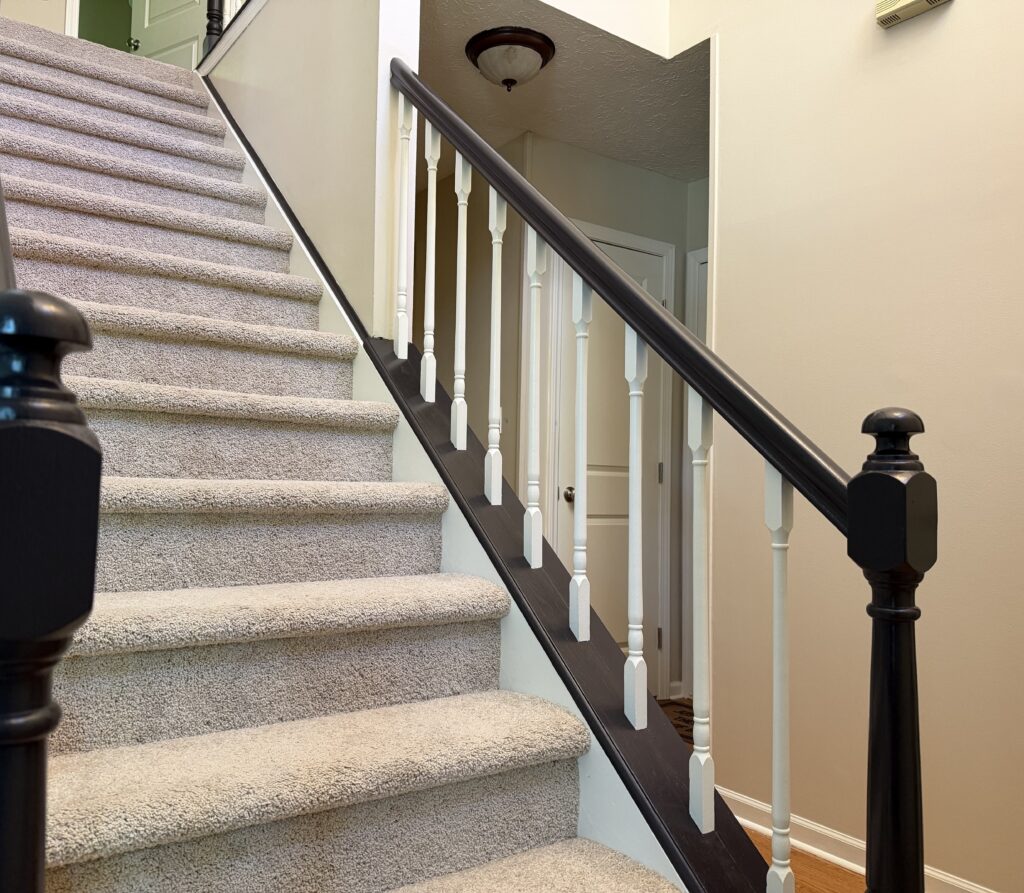
Thirty spindles, two colors, one very long two weeks. Here’s the sequence and technique that worked.
Our staircase was original to the house — 1989 builder oak, that particular shade of orange that was everywhere in that era and somehow made it through three decades without anyone doing anything about it. We finally did something about it. The interior doors got the same treatment eventually — 14 doors over five years — but the staircase was the project we kept putting off. The same orange oak ran along every baseboard in the house, too.
The result looks great. The photo at the top of this post is proof. But getting there involved a spindle technique that took some trial and error, a black paint situation that humbled me, and a hardening timeline that the can doesn’t adequately warn you about.
Here’s what I’d tell someone starting this project.
Do the sequence in this order: prime everything, paint white, paint black
If you’re doing a two-tone staircase — white spindles, black railings, for example — the order you work in matters more than you’d think.
Prime everything first. All of it, regardless of final color. White primer on the spindles, white primer on the railings. Don’t worry about primer from the spindles landing on the railing or vice versa — you’re going to paint over all of it anyway. Getting everything primed in one pass is faster and cleaner than trying to be precise at the primer stage.
Then paint all the white parts, top to bottom.
Then come through with the black.
The reason: white paint splatters when you’re working the spindles. Some of that is going to land on the railing. If you paint the railing black last, you cover it. If you paint the railing black first, you’re touching it up constantly and hoping white doesn’t show through dark paint. It does. It’s a pain.
The spindle technique that worked
Thirty spindles sounds manageable. It is not quite as manageable as it sounds.
Each spindle has three sections — a square top, a turned round middle and a square bottom. Each section requires a slightly different approach, and the round middle section is where most people run into trouble.
Here’s what worked for me after some trial and error:
For the square sections: Load the brush, paint from top to bottom, then make quick short strokes to smooth the paint out before it starts to set. Don’t overwork it.
For the round middle section: Same approach — load the brush, coat the spindle — but use quick side-to-side strokes to smooth it rather than top-to-bottom. The round shape means top-to-bottom strokes leave runs. Side-to-side catches them.
One mistake I made on the first coat: I painted one side of each spindle, let it dry, then came back for the other side. That left a visible line where the two sessions met. For every coat after the first, I worked quickly from one side to the other without stopping — keeping a wet edge the whole way around. No more lines.
I used a 1-inch brush throughout. I tried a round brush (too many drips) and a small roller (impossible to maneuver between spindles without making a mess). The 1-inch brush was slower but gave me the most control.
One special case: there was a spindle attached directly to the wall with a small gap between the edge and the wall. A 1-inch brush couldn’t get in there. I used a small kids paintbrush for that gap — it didn’t hold much paint so it took a few passes, but it was the only thing that fit.
The drip problem is real, and it comes from the round section
Those quick side-to-side strokes on the round middle section? They work, but they also fling tiny drops of paint onto whatever is nearby — including the railings you just carefully painted black.
I didn’t find a great solution for this. What I did: keep a damp rag nearby, check the railings frequently and wipe any drops immediately before they dry. Dried white paint on a black railing is a sanding job. Fresh white paint on a black railing is a 10-second fix.
Plan for it rather than being surprised by it.
Black paint is a completely different animal
I used Benjamin Moore Advance Waterborne Alkyd in a very dark charcoal for the railings, newel posts and shoe rail. It looks black. It paints like a challenge.
A few things I didn’t expect:
It shows everything. Every brush stroke. Every bit of lint or dust that lands in the wet paint. Every fingerprint. The railings run along the wall and face upward toward the light, which means they catch every imperfection at every angle. I had to be far more careful and intentional than with the white.
White under black is fine. Black under white is not. If I accidentally got white paint on a railing, I painted black over it. If I accidentally got black paint on a spindle, I was sanding and repainting. Work white first for this reason.
More coats than you expect. I did four coats plus primer on the black pieces. The white got three coats plus primer. On the bottoms of the railings — the part you don’t see unless you’re looking — I’ll confess I did two coats. I’m the only one who knows that.
The technique for curved railings: I worked in 2-3 foot sections. Load the brush, almost glob the paint along the top of the railing first, then work it into the curved sides, then make long quick strokes along the top to smooth everything out before moving to the next section. Keeping a wet edge between sections is what prevents visible overlap lines.
The tape-and-cut technique for curved edges
Where the railing meets the wall at the top of the stairs, you can’t just run a straight line of tape. The railing curves.
What worked: a series of short pieces of tape fanned out from the railing edge, overlapping slightly, following the curve. Then — carefully — a small utility knife to cut the tape right along the edge of the wood. Take your time here. A slip of the knife either cuts into the wall or leaves a gap that paint bleeds through.
For the straight sections along the baseboard trim on the stairs, standard painter’s tape worked fine. The curved sections required patience.
The hardening time will surprise you
Both paints I used — Sherwin-Williams Urethane Trim Enamel for the white and Benjamin Moore Advance for the black — dry to the touch in a few hours. That is not the same as hardening.
We kept our hands off the railings for a week. Some reviews I read said the enamel can take up to three weeks to fully cure. I believe it. In the first week or two, even careful contact left marks. I had to touch up four spots on the black:
- A scratch at the base of the newel post from carpet installation
- A hit from someone swinging a bag into the round newel post cap
- A kick to the bottom of the post near the front door
- A scrape down the handrail from the small metal rivets above a pocket on my jeans
The last one was entirely my fault and deeply annoying.
If you have kids or pets, tape off what you can and warn everyone. The paint looks done before it is done.
It will take longer than you think
The staircase took me two weeks. I was working in off hours around a full-time job, but still — two weeks for a staircase surprised me.
The spindles are the culprit. I had to stop after every 8-10 just to give my brain a rest. They’re repetitive and detail-oriented in a way that wears you down. Budget more time than you think you need and don’t try to rush the end.
The one thing that makes all of this easier
Use paint that self-levels. I’ve used cheaper trim paints that don’t, and brush strokes stay visible no matter what you do. Both paints I used self-level as they dry, which forgives a lot. It’s worth paying for.
The difference between a DIY paint job that looks amateur and one that looks professional is often just the paint.
Products used: Benjamin Moore Advance Waterborne Alkyd, Sherwin-Williams Urethane Trim Enamel, painter’s tape, 1-inch trim brush, utility knife.
Step by Step
How to paint stair spindles and railings in a two-tone finish.
- Prime everything in one pass
Apply primer to all spindles and railings regardless of final color. Don’t try to keep primer within color zones — you’re painting over all of it anyway. White primer on everything in one pass is faster than trying to be precise at the primer stage.
- Paint all white parts first
Paint spindles and any other white elements top to bottom. Use a 1-inch trim brush. On round middle sections, use quick side-to-side strokes rather than top-to-bottom to prevent runs. Keep a wet edge the whole way around each spindle — painting one side, letting it dry, then coming back for the other leaves a visible line.
- Paint black parts last
Work in 2-3 foot sections on railings. Load the brush, work paint into the curved sides, then make long quick strokes along the top to smooth before moving on. Black shows everything — keep a consistent wet edge between sections to prevent overlap lines.
- Manage spindle drips immediately
Side-to-side strokes on round spindles throw tiny drops onto nearby railings. Keep a damp rag nearby and wipe white drops off the black railings before they dry — fresh paint is a 10-second fix, dried paint on a dark surface is a sanding job.
- Wait the full cure time before use
Trim enamels dry to the touch in a few hours but can take up to three weeks to fully harden. Keep hands off railings for at least a week. In the first week or two, even careful contact can leave marks — warn anyone using the stairs before the cure is complete.
Common Questions
A 1-inch trim brush gives the most control on round spindles. Round brushes drip too much on the curved sections, and rollers can’t maneuver between spindles without making a mess. Use side-to-side strokes on the round middle section rather than top-to-bottom — this prevents runs.
White spindles needed three coats plus primer. Dark railings took four coats plus primer to cover evenly — dark paint is more demanding than it looks. The underside of the railings, the parts you don’t see from above, can get away with two coats.
Trim enamels dry to the touch in a few hours but can take up to three weeks to fully harden. In the first week or two, even careful contact can leave marks. Keep hands off the railings for at least a week, and warn anyone who uses the stairs before the cure is complete.
Yes. Prime everything before you start painting — all spindles and railings in one pass, regardless of final color. Don’t try to be precise at the primer stage; you’re going to paint over all of it anyway. Primer is what the paint sticks to, and priming in one pass is faster than trying to keep primer within color zones.